
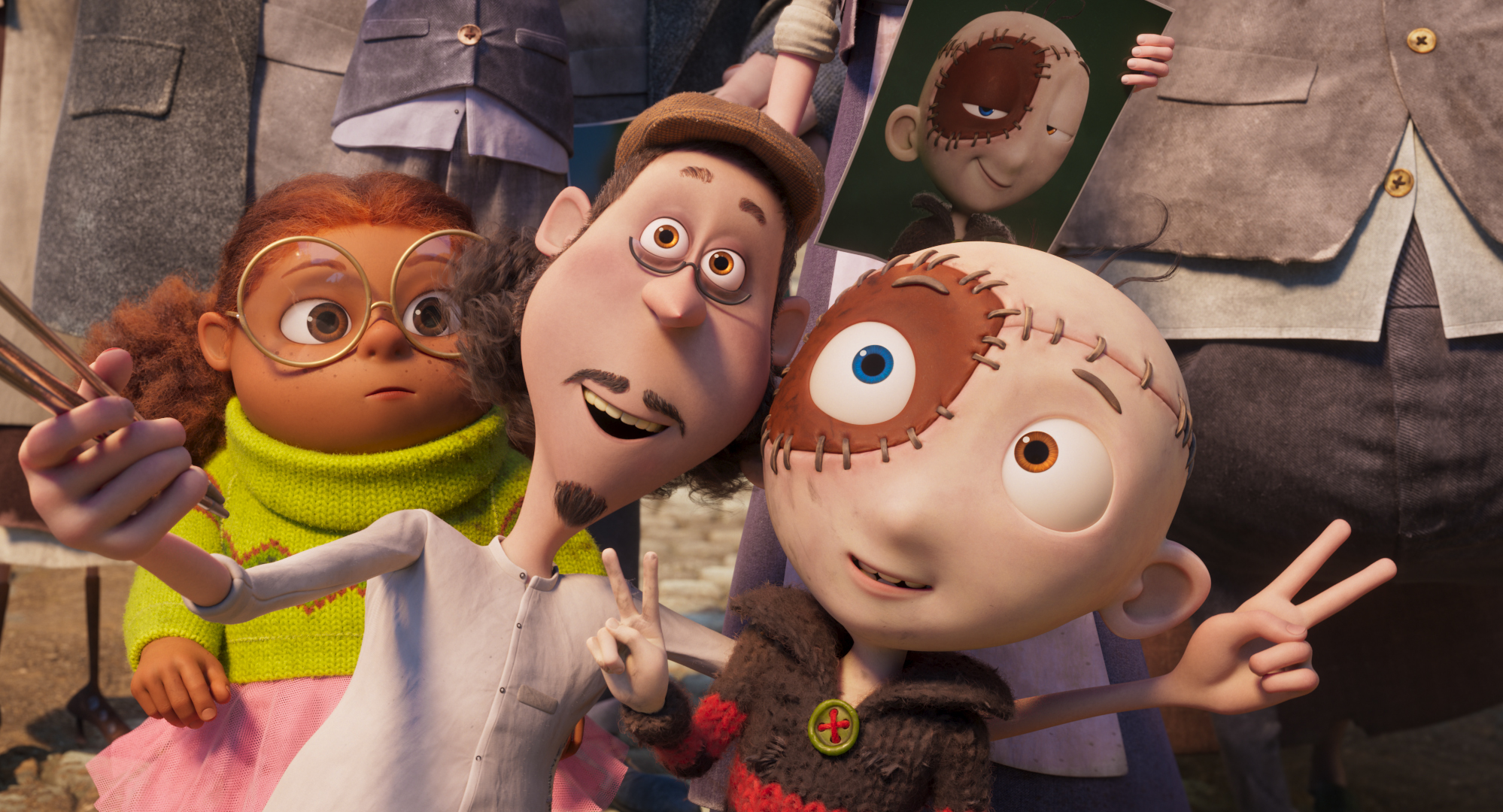
Stitch Head is an animated film that came out in February 2026. It follows the adventures of titular character Stitch Head as he comes to accept being different from the humans in the town below the castle laboratory he was created in, while teaching them to be a little less “monstrous”.
Campaigner Eden is a filmmaker herself, so she was perfectly placed to hold a Q&A with the director, Steve Hudson, about the inspiration behind bringing Stitch Head to the big screen.
Stitch Head is your first animated feature film, what was it about this story that drew you to make your directing debut in animation?
Firstly, all the fun! Guy Bass’ book, on which the film is based, is hilarious, and the whole underlying Frankenstein myth is a part of our cinematic collective unconscious: it gave us so much space to play and have fun as filmmakers.
Whether it’s with the music, sound effects, sets or camera angles – we can play with and against all the clichés.
Secondly, and even more importantly, the books are so emotional, and so touching. Stitch Head is a little kid who’s been abandoned – left with the adult responsibility of looking after all his fellow-monsters. He sees his life as a tragedy. Our hearts went out to him. This really matters. If you’re going to spend five years making a film, you want it to really mean something.
Stitch Head’s journey reflects many of the social and emotional experiences that people with visible differences face on a daily basis. Were you always aware of how resonant the film might be with the visible difference community?
It was always implicit, but what do I know? I’d be much more interested to hear how it felt for the visible difference community.
Stitch Head is set amidst the fantastical backdrop of Grubbers Nubbin. How did you approach combining such relevant and poignant messaging, within this gothic fantasy/comedy piece? What were the challenges to ensure the themes maintained impact?
This may sound odd, but I don’t really see a conflict between poignancy and fantasy or comedy. Whether it’s Beauty and the Beast, Edward Scissorhands, or Tod Browning’s astonishing 1932 movie Freaks (which caused such a furore that the studio tried to destroy it) it’s the fantasy and the comedy that brings us up close to the character.
In cinema, the camera has an amazing ability to show not the labels applied from the outside, but the humanity from within. And in the end, this humanity is the basis of the very best humour, a humour that lives from empathy with misfortune.
Take Creature leaving the Castle, convinced that he’s going to certain death – but unable to get a word out clearly because of all his ridiculous camouflage. It’s funny because it hurts, because we feel for him. It’s like crying in another key.
Do you have a personal connection to the story? How did you draw from your experiences, or any external sources of inspiration to create such a resonant message?
There were parts of my childhood and younger years that really weren’t easy. Externally, I was very cocky, but inside I often felt like an outsider, an imposter, at times even totally worthless. Like both Stitch Head and Freakfinder, I was desperate for ‘love’ – i.e. external recognition.
In the film, Stitch Head has to learn that love is not something we have to earn or possess. It’s inherent in community and solidarity, which are the most natural, organic feelings we have from the earliest childhood. We live in a social order that constantly pushes us to repress these feelings, to treat people as means to an end – or to not see them at all. It’s not easy, but I’m hoping to learn the same lesson as Stitch Head.
The first instalment of Stitch Head (written by Guy Bass) in the six-book series was published in 2011, well over a decade ago. Why is now the right time to bring this story to the screen?
This wasn’t exactly deliberate timing on our part! We first encountered the book some eleven years ago. It took five years to write the script and get the film financed, and another five years to actually make it. I wouldn’t have minded if we’d managed it all a bit quicker!
Did you have to condense the material from the book to adapt it to screen? Were there any moments in Stitch Head’s journey of self-discovery and social navigation that you wish you could have further explored?
If anything, the original book was a little too short: it would have made a 30-minute film. As such, the whole middle act, where Stitch Head joins the circus, was added in. In the book, Freakfinder comes to the Castle promising Stitch Head that audiences will ‘love’ him and recruits him to his freak show. In a world dominated by Instagram and selfies, where love is a metric, measured in likes, it seemed really important to actually explore this by having Stitch Head join the circus, and become a star.
Your feature film, True North (2006) is a raw portrayal of the lived experiences of Chinese immigrants. Is there something about hardship, or exploring unconventional perspectives of life that you are drawn to exploring and why?
There’s a great African American expression: to walk a mile in someone else’s shoes. It’s so much stronger than the rather glib British equivalent of ‘putting yourself in someone else’s shoes’. In life, we’re often quick to judge people, to condemn them even. But walk a mile in their shoes, feel the pinching leather, the blisters, the weight… and maybe we’d see things differently. In day-to-day life, empathy is constantly repressed. We see people left to sleep on the street in the freezing cold and are told it’s normal. It’s not. It’s horrific. For me, that’s what cinema is ultimately for: for reawakening empathy, a little humanity, that we can take back into the world outside.
On the topic of unconventional – many of the preconceived judgements we make are a product of the consumed media that have shaped our ideas of the world from a young age. Is it time to make unconventional heroes, conventional? And how do you see Stitch Head being a part of this social shift?
Going back as far as Mary Shelley’s Frankenstein, it’s the ‘Monster’ who is by far the most humane character, so I guess this is probably an ongoing struggle that’s been waged a long time and may never be conclusively won or lost.
Nonetheless, it’s a struggle where we can, should and at times even do make progress. So, for me, it’s a strong yes to unconventional heroes. Feeling like an outsider, like an outcast, like NOT belonging to humanity is the most universal, the most human emotion that we have. It’s when we repress that feeling – taking the bully’s way out, creating an artificial sense of belonging to the ‘right’ group by attacking the weakest – that we go down the road to fascism.
In that sense, it’s maybe also about seeing prescriptive definitions of ‘normal’ as the antagonist. This may be a bit of a downer, but I think it’s also important to look at the bigger picture: We seem to have entered a period in the West where, materially, life is slowly but surely getting worse for the vast majority of people. It’s a volatile situation, and like Freakfinder, the strongest in our society are playing on hate and fear to hold on to their power – distracting us from their crass exploitation by scapegoating the weakest. One group may be in the crosshairs today, but it will be another tomorrow, and one day the bullies will come for us.
We can only prevail if we come together, rediscovering solidarity and community, overcoming difference. This is not just a question of morality, but of self-preservation. It will be a learning journey for all of us.
Changing Faces ‘A Face for Radio’ campaign centres on encouraging casting directors and brands to broaden the representation of visible differences in the media. As an acclaimed Director, how do you think the industry can make changes to broaden this important on-screen representation?
As a straight, white, middle class, English, able-bodied male, I’ve been born into a bunch of privileges which so many people don’t enjoy, so frankly – you should be telling me, not the other way round. I’m also really not acclaimed, and I’m sure that there are stories within the visible difference community which are stronger and more emotional than any I could tell.
I’d sincerely like to see these stories – and I’m sure many others would too. Not just to encourage social dialogue and increase acceptance, but because of their humanity: stories not just about people with visible difference, but by people with visible difference. Stories whose characters, as in life, are not limited to, or defined by, this visible difference. The whole point is to see beyond external prejudice to discover the genuine individuality beneath.
What changes can the industry make? Firstly, just listen. Meet you. Open the door. Commission scripts. Cast actors. Think critically about their own output, rather than just churning out harmful clichés. But let’s be honest: Getting films financed and made is incredibly hard. Industries, corporations and brands act in their own self-interest, and, frankly, will only change when forced to do so.
So, my appeal would also be to you: Bang on the industry’s door, keep banging, never take no for an answer, but, if need be, make the films you want to see without them. The best change comes from below.