
TW: Eating disorder
Growing up with a rare skin condition, I never acknowledged or thought about the marble patterned birthmark all over my body. I never questioned it – after all, I was born that way. However, as I grew older, I realised that people were very inquisitive as to why I looked the way I do, that’s when I started to become aware that I was different.
A core memory that sticks with me is a young girl in ballet class being scared to hold my hand because she thought I looked ‘weird’. I had to learn very quickly to reframe negative comments about my skin to something positive.
I think my parents anticipated that my self-confidence could be a challenge growing up. They referred to my marks as special, calling them angels kisses, and I would tell people I was a chameleon as my skin would change colour depending on the weather. However, as much as you try to deflect the uncomfortable questions with humour – you can’t deny that a part of you always wondered what it would be like to look ‘normal’.
As I went into high school, I grew envious of the girls with smooth, soft, ‘perfect’ skin. I blamed my skin as a reason for the lack of interest I received from boys. I certainly questioned if this was the reason I felt nobody liked me. Finding love with a visible difference felt impossible. I spiralled into a deep eating disorder during this time – I believed that If I starved my body, it would make-up for the ‘flaws’ in my physical appearance. Navigating this as a teenager was difficult- it made me upset how cruel I was to my body because I lacked confidence in my authentic self.
After all those years of self-doubt, re-inventing my physical appearance, wishing for people to like me who never truly cared about me, I realised it was never about me, or the way I looked.
But something that comforted me was realising that I wasn’t the only person suffering from insecurity. I realised that everyone was dealing with their own set of insecurities about their physical appearance too. And also, I began to understand that my condition was irreversible, why not learn how to love it rather than live with resentment.
When I went to University, my perspective shifted entirely. For the first time in my life – I received male attention. I’d always thought that nobody was interested in me romantically due to my marked skin. However, it struck me that I was never the problem. I grew up with such a small circle of familiar faces, my perspective of the world is so warped. I realised that it was never my appearance that hindered romantic relationships – it was the lack of emotional connection, a difference in personality, interests and world views.
Despite this realisation, University culture can be relatively surface level, and so the self-doubt began to creep back in. The newfound romantic attention I was receiving was exciting. I didn’t want to lose that feeling that I felt I’d lacked as a teenager. I never truly opened myself up to anyone because I was afraid of being rejected or feeling unwanted. And I was worried that if that were to happen, I’d blame it on my condition again.
I have a small amount of my skin condition that marks the side of my face. For years I would cover up the markings with foundation, even after I showered. Because I was afraid to let anybody see the full, real me. Hiding behind that mask impacted my behaviour also- because I was never able to truly be myself.
However, I met someone who somehow brought out the authentic Eden that had been hiding behind a protective mask for so long. He made me feel so safe to be myself, that I stopped covering up the marked side of my face.
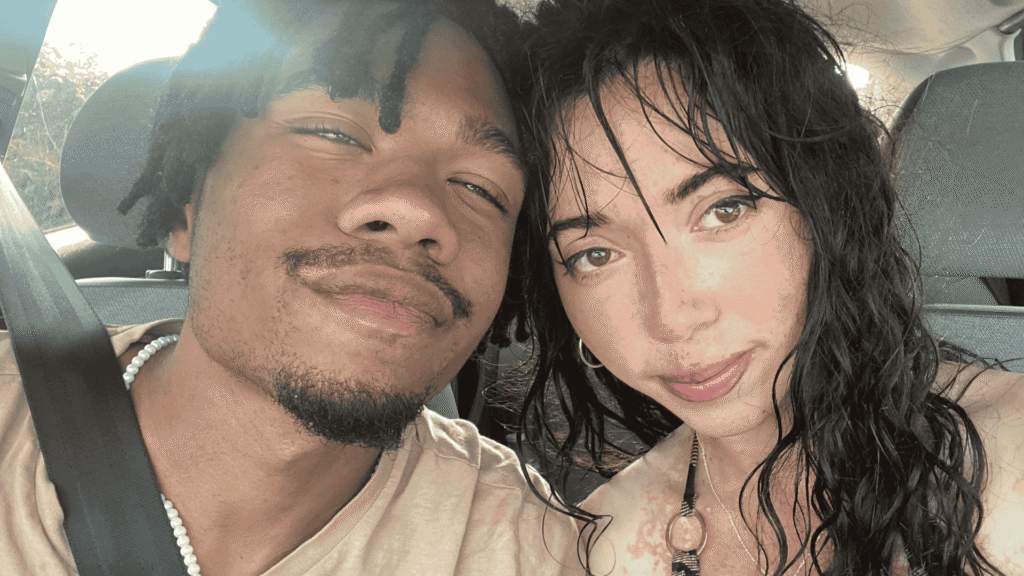
Eden discovered that love is about shared energy and respect, not appearance
I realised that all the comments about my body, the men who made me feel like physical attraction was the reason for our connection, were so wrong. I understood that those relationships were so surface level. It was never about love; it was about a false sense of self validation on both parts. I began to gain back clarity and understand that there was somebody out there who was intrigued by who I was, as a person. A man who loved the energy I brought into a room, the way I held myself, treated others – and someone who allowed me to be sensitive, vulnerable and true to myself.
After all those years of self-doubt, re-inventing my physical appearance, wishing for people to like me who never truly cared about me, I realised it was never about me, or the way I looked. Because somebody fell in love with the true me, he saw who I was. He could sense I was guarded and still somewhat hiding behind a protective shield, but none of that mattered because all he cared about was bringing out the authentic Eden that he’d always seen from a distance. Even when nobody else did. We share a deep empathy, values, humour, and emotional maturity. I understood for once in my life that it was about ultimate compatibility, on a deeply emotional level. And that’s not going to be the case with everyone you meet.
Love isn’t always right in-front of your face. Sometimes the people who truly see you and understand you are watching and admiring from afar.